


About the DD-FX Series
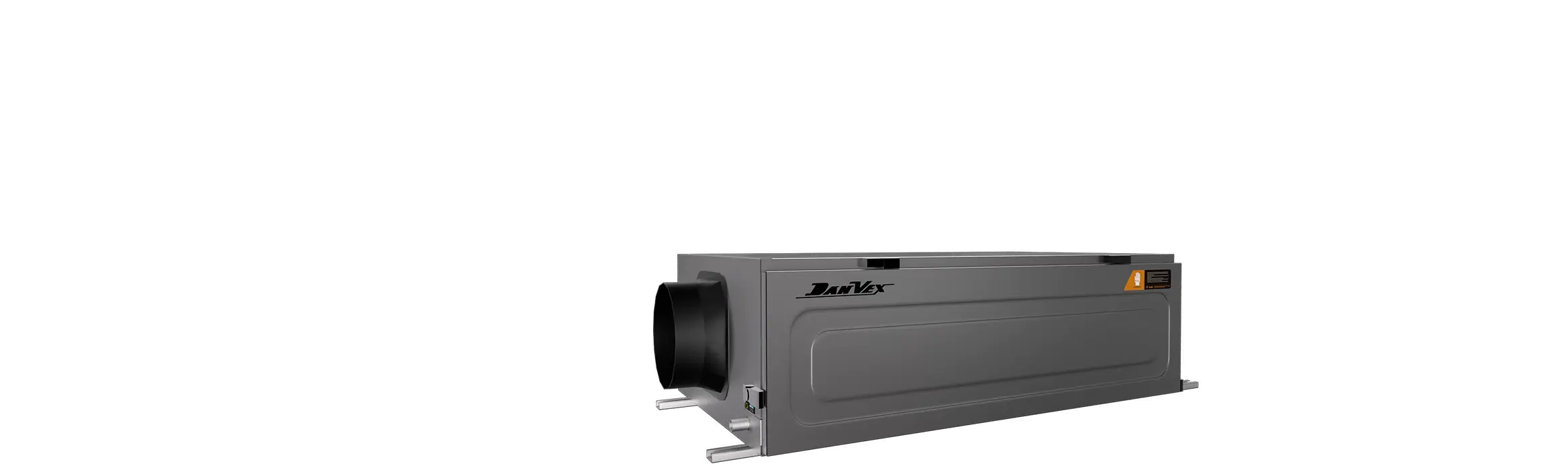
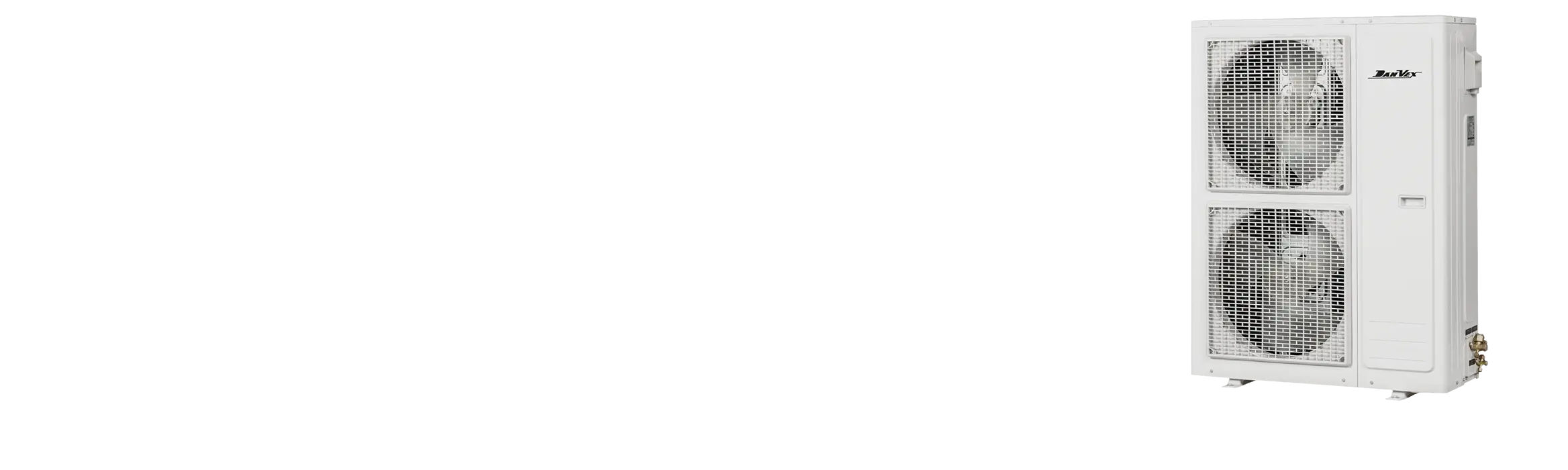
The DanVex DD-FX Series is a range of ducted Split System units combining dehumidification, heat-pump heating and cooling, ventilation, three-stage filtration and adiabatic humidification in a single installation. Each system consists of an Ultra-Slim indoor unit (concealed in a ceiling void or plant area) and an outdoor condenser unit (IPX4-rated for direct outdoor installation). Refrigerant piping, a power cable and communication wiring connect the two; ductwork connects to the indoor unit only.
Series ranges: dehumidification from 92 L/day (DD-136FX) to 360 L/day (DD-960FX); cooling 5.4–21 kW; heating 5.9–24 kW; adiabatic humidification 2–8 kg/h. Supply airflow 350–1800 m³/h at 180–300 Pa static pressure — sufficient for residential and commercial networks. Operating range +6…+48 °C ambient — the system holds room conditioning across a wider climate envelope than typical split air conditioners.
The DD-FX replaces five separate installations: a ducted dehumidifier, a heat-pump heating and cooling unit, a fresh-air ventilation unit, a HEPA air purifier and an adiabatic humidifier. The Auto Climate mode — driven by the 5-in-1 sensor on the return stream and a temperature + humidity sensor on the supply air — regulates all five functions autonomously on continuous measurement of indoor conditions. All models use R-32 refrigerant, an inverter compressor paired with an inverter fan and EEV for continuous regulation of airflow and refrigerant flow, E-Coating heat-exchanger protection, Modbus RTU RS-485 + Wi-Fi connectivity and UV + Anion purification with Antifungus treatment.
Models in the range
DD-136FX 92 L/day · cooling 5.4 kW · heating 5.9 kW · humidification 2 kg/h · 350 m³/h · 180 Pa · 1-Ph + 1-Ph · Full Inverter · HEPA H13 · E-Coating
Indicative coverage: ~50–90 m² depending on ceiling height and target conditions
The smallest model — luxury residential studios and one-bedroom apartments, beverage cellars, single server-room installations, boutique hotel rooms. R-32 × 2.5 kg, noise below 35 dB(A).
DD-168FX 140 L/day · cooling 8.2 kW · heating 9.8 kW · humidification 3 kg/h · 550 m³/h · 200 Pa · 1-Ph + 1-Ph · Full Inverter · HEPA H13 · E-Coating
Indicative coverage: ~80–130 m² depending on ceiling height and target conditions
Medium residential and small commercial — family apartments, larger beverage cellars, small medical consulting rooms, luxury serviced apartments. R-32 × 3 kg, noise below 38 dB(A).
DD-240FX 192 L/day · cooling 10 kW · heating 12.3 kW · humidification 4 kg/h · 750 m³/h · 200 Pa · 1-Ph + 3-Ph · Full Inverter · HEPA H13 · E-Coating
Indicative coverage: ~130–200 m² depending on ceiling height and target conditions
Larger residential and commercial — luxury family homes, multi-room hotel suites, medical clinics, IT rooms with HEPA requirements, laboratory instrument areas. R-32 × 3.5 kg, noise below 40 dB(A).
DD-380FX 240 L/day · cooling 12 kW · heating 13.5 kW · humidification 5 kg/h · 950 m³/h · 200 Pa · 1-Ph + 3-Ph · Full Inverter · HEPA H13 · E-Coating
Indicative coverage: ~180–280 m² depending on ceiling height and target conditions
Large residential and boutique commercial — large homes, boutique hotels, executive offices, restaurant dining rooms, multi-zone clinics. R-32 × 4.2 kg, noise below 40 dB(A).
DD-480FX 288 L/day · cooling 15 kW · heating 17.5 kW · humidification 6 kg/h · 1150 m³/h · 250 Pa · 1-Ph + 3-Ph · Full Inverter · HEPA H13 · E-Coating
Indicative coverage: ~250–380 m² depending on ceiling height and target conditions
Large commercial and small industrial — boutique retail complexes, luxury spa and wellness centres, medium server rooms, multi-zone laboratories, large medical facilities. R-32 × 5 kg, noise below 42 dB(A).
DD-720FX 336 L/day · cooling 18 kW · heating 20 kW · humidification 7 kg/h · 1500 m³/h · 250 Pa · 1-Ph + 3-Ph · Full Inverter · G4 + F7 · E-Coating
Indicative coverage: ~350–500 m² depending on ceiling height and target conditions
Large commercial — hotel and spa complexes, large executive offices, multi-zone medical centres, large server rooms, luxury retail and hospitality. R-32 × 5.5 kg, noise below 45 dB(A).
DD-960FX 360 L/day · cooling 21 kW · heating 24 kW · humidification 8 kg/h · 1800 m³/h · 300 Pa · 1-Ph + 3-Ph · Full Inverter · G4 + F7 · E-Coating
Indicative coverage: ~450–650 m² depending on ceiling height and target conditions
The largest model — large boutique commercial, multi-storey luxury installations, large hotel and spa complexes, large laboratories, luxury pre-cleanroom spaces. R-32 × 6.5 kg, noise below 45 dB(A).
Coverage figures are indicative for typical residential and boutique-commercial conditions (moderate moisture and heat load, 2.5–3.5 m ceilings, ordinary air-change rates). Climate-control selection depends on cooling, heating and moisture loads together — for precise selection, contact us with the project data.
Which model should I choose?
The right choice is decided by the combined load — cooling, heating, dehumidification and humidification are sized together. The two smallest models run entirely on single-phase 220–230 V (indoor and outdoor units); the larger models keep the indoor unit single-phase and require a three-phase 380–415 V supply for the outdoor condenser.
| Criterion | DD-136FX | DD-168FX | DD-240FX | DD-380FX | DD-480FX | DD-720FX | DD-960FX |
|---|---|---|---|---|---|---|---|
| Dehumidification (L/day) | 92 | 140 | 192 | 240 | 288 | 336 | 360 |
| Cooling / heating (kW) | 5.4 / 5.9 | 8.2 / 9.8 | 10 / 12.3 | 12 / 13.5 | 15 / 17.5 | 18 / 20 | 21 / 24 |
| Humidification (kg/h) | 2 | 3 | 4 | 5 | 6 | 7 | 8 |
| Supply airflow (m³/h) | 350 | 550 | 750 | 950 | 1150 | 1500 | 1800 |
| Outdoor unit supply | 1-Ph | 1-Ph | 3-Ph | 3-Ph | 3-Ph | 3-Ph | 3-Ph |
| Filtration | HEPA H13 | HEPA H13 | HEPA H13 | HEPA H13 | HEPA H13 | G4 + F7 | G4 + F7 |
| Coverage (m²) | ~50–90 | ~80–130 | ~130–200 | ~180–280 | ~250–380 | ~350–500 | ~450–650 |
Where is the DD-FX Series used?
The series targets installations where a single ceiling unit must deliver full climate control — temperature, humidity, fresh air and filtration — at the same time:
Application guide
| Application | Target temperature / humidity | Why DD-FX | Recommended models |
|---|---|---|---|
| Luxury residential homes | 20–24 °C / 40–55% | One ceiling unit covers heating, cooling, dehumidification, fresh air and HEPA — replaces five systems | DD-168FX · DD-240FX · DD-380FX |
| Beverage cellars | 10–14 °C / 65–75% | Low-temperature cooling down to +6 °C; precise humidification for cork integrity | DD-136FX · DD-168FX · DD-240FX |
| Server rooms and data centres | 18–24 °C / 40–55% | ASHRAE TC 9.9 compliance; HEPA H13 against fine-dust deposition; redundant operation | DD-240FX · DD-380FX · DD-480FX |
| Laboratories and cleanrooms | 18–24 °C / 30–60% | Precise joint temperature and humidity control; HEPA H13; pressure-stable supply | DD-240FX · DD-380FX · DD-480FX |
| Healthcare clinics | 20–24 °C / 30–60% | ASHRAE 170 compliance; HEPA-grade filtration; fresh air with CO₂ control | DD-168FX · DD-240FX · DD-380FX · DD-480FX |
| Boutique hotels and spas | 20–26 °C / 45–60% | Single-system aesthetics; quiet operation; climate per zone | DD-380FX · DD-480FX · DD-720FX |
| Radiant cooling systems (chilled ceilings / walls / floors) | Dew point below the chilled-surface temperature | Neutral-temperature dehumidification prevents condensation on radiant surfaces — the first operating condition | DD-240FX · DD-380FX · DD-480FX · DD-720FX |
| Museums and private galleries | 18–22 °C / 45–55% ±5% | Tight joint temperature and humidity stability; HEPA against airborne particles | DD-168FX · DD-240FX · DD-380FX |
| Luxury retail floors | 20–24 °C / 40–55% | Integrated climate with no visible equipment; CO₂-driven fresh air for footfall peaks | DD-480FX · DD-720FX · DD-960FX |
Split System architecture and integrated operation
The DD-FX is a Split system: an Ultra-Slim indoor unit concealed in the ceiling void, and an IPX4-rated outdoor condenser mounted on an exterior wall, balcony, roof or ground base. R-32 piping, a power cable and shared communication connect the two, with condensate drainage on the indoor unit.
One installation, five functions. Each system delivers five climate functions at once: dehumidification through the refrigerant cycle; cooling through the same cycle in cooling mode (5.4–21 kW); heating by heat-pump operation with the cycle reversed (5.9–24 kW, across the full +6…+48 °C ambient range); ventilation through the fresh-air inlet with an automatic damper (0–500 m³/h); and humidification through the adiabatic humidification module (2–8 kg/h water evaporation across a wetted media pad). Three-stage filtration (G4 + F7 + HEPA H13 on most models, G4 + F7 on DD-720FX / DD-960FX) works across all modes.
Auto Climate mode. The 5-in-1 sensor on the return stream continuously measures CO₂, PM2.5, TVOC, humidity and temperature, and a supply-air sensor (temperature + humidity) monitors the delivered conditioning. The controller adjusts compressor speed, fan speed, fresh-air damper position, humidifier activation and reheat balance to the continuous measurements — with no user input after the initial set-points. A manual mode is available for project-specific operating profiles.
Dehumidification without raising air temperature. Unlike conventional dehumidifiers, which return the heat of condensation to the supply stream and warm the room, the DD-FX balances the heat-pump cycle between dehumidification and reheat — delivering dry air at neutral or reduced temperature according to the set-point. This property is critical for the UAE climate, and it is the technical basis for DD-FX operation with radiant cooling systems (chilled ceilings, walls and floors): the system holds the room-air dew point below the cold-surface temperature and prevents condensation on it — the first operating condition of any radiant cooling installation.
Low-temperature cooling down to +6 °C. Most split air conditioners falter below +18 °C room temperature because the refrigerant cycle loses efficiency and the evaporator coil ices up. The DD-FX is designed for continuous operation down to +6 °C room temperature with full cooling and dehumidification — the right choice for beverage cellars, server rooms, cold laboratories and cold museum stores. The Hot Gas Defrost system keeps operation going in cold conditions without the long defrost cycles that interrupt conventional heat pumps.
Where does DD-FX not fit? High-capacity industrial duty above 360 L/day — use the DD Series (up to 960 L/day) without climate control. Pure ducted dehumidification without heating/cooling/humidification — use DD or DD-F (lower cost). Cleanrooms with an H14 / ULPA requirement (operating theatres, Grade A pharma) — the DD-FX uses H13, suitable for most contexts but not full Grade A.
How does DD-FX compare with the alternatives?
| Alternative | When it beats DD-FX | When DD-FX is better |
|---|---|---|
| Multi-Split air conditioner (heating and cooling only) | No humidity or fresh-air requirement; pure heating/cooling for ordinary apartments and offices; lower price. | Humidity control, CO₂-managed fresh air, HEPA filtration and humidification are required beyond heating/cooling — the DD-FX delivers all five in one installation. |
| Central air conditioning (AHU with reheat coil, humidifier and HEPA bank) | A very large facility (above 2000 m²); humidity and air-quality strategy at AHU level; new-construction stage. | Retrofits; local climate-control zones (individual rooms or floors); faster schedule; lower cost; zone-by-zone optimisation. |
| DD or DD-F + separate heat pump + ERV + humidifier (modular approach) | A partial installation already exists (e.g. a heat pump is installed); phased capital spending; specific architect preferences for equipment. | One ceiling installation, one controller, one commissioning and one service contract — a substantial aesthetic and operational simplification. |
| VRF system (variable refrigerant flow, multi-zone) | Many small zones (10+) across a large building; per-room temperature control is the primary requirement; large commercial. | A single-zone or few-zone installation; humidity control, fresh air and HEPA are part of the requirement; lower operational complexity. |
Key technologies — at a glance
- Split System architecture — concealed Ultra-Slim indoor unit + IPX4 outdoor condenser; ductwork connects to the indoor unit only
- Full Inverter across the range — inverter compressor, inverter fan and EEV as one system; ±2–3% RH stability and energy savings up to 40% versus fixed speed
- Heat-pump heating and cooling — a reversible cycle delivers 5.4–21 kW cooling and 5.9–24 kW heating; typical COP 3.5–4.5
- Dehumidification without raising air temperature — reheat balance in the heat-pump cycle delivers dry air at neutral or reduced temperature; the technical basis for working with radiant cooling systems in the Gulf climate
- Low-temperature cooling down to +6 °C — for beverage cellars, server rooms and cold stores where standard split units stop
- Adiabatic humidification module — 2–8 kg/h water evaporation across a wetted medium; cools and humidifies at once; no boiler, no scale, no chemical treatment
- Three-stage filtration — G4 + F7 + HEPA H13 on most models (G4 + F7 on DD-720FX / DD-960FX); H13 captures at least 99.95% at MPPS
- 5-in-1 sensor + supply sensor — continuous measurement on the return and temperature + humidity on the supply; autonomous Auto Climate operation
- Automatic fresh-air valve — CO₂-driven outdoor intake (0–500 m³/h by model); HEPA-filtered before mixing
- Hot Gas Defrost — routes hot compressor gas directly into the coil, melting ice quickly and keeping operation going in cold conditions
- UV + Anion + Antifungus — in-stream sterilisation and antimicrobial coating inside the housing; self-cleaning inside the unit
- E-Coating on the heat exchanger across the range — an electrochemical anti-corrosion layer resistant to chlorine-laden, marine and high-humidity environments
- Wi-Fi + Modbus RTU RS-485 standard on every model; BMS / SCADA integration with auto-restart that keeps settings
Technical specifications — DD-FX Series
| Parameter | DD-136FX | DD-168FX | DD-240FX | DD-380FX | DD-480FX | DD-720FX | DD-960FX |
|---|---|---|---|---|---|---|---|
| Dehumidification (30 °C / 80% RH) | 92 L/day | 140 | 192 | 240 | 288 | 336 | 360 |
| Rated cooling | 5400 W | 8200 | 10 000 | 12 000 | 15 000 | 18 000 | 21 000 |
| Rated heating | 5900 W | 9800 | 12 300 | 13 500 | 17 500 | 20 000 | 24 000 |
| Humidification capacity | 2 kg/h | 3 | 4 | 5 | 6 | 7 | 8 |
| Supply airflow | 350 m³/h | 550 | 750 | 950 | 1150 | 1500 | 1800 |
| Fresh-air flow | 0–175 m³/h | 0–225 | 0–250 | 0–300 | 0–350 | 0–400 | 0–500 |
| Return airflow | 175–350 m³/h | 275–500 | 500–750 | 650–950 | 800–1150 | 1100–1500 | 1300–1800 |
| External static pressure | 180 Pa | 200 | 200 | 200 | 250 | 250 | 300 |
| Refrigerant | R-32 × 2.5 kg | × 3 kg | × 3.5 kg | × 4.2 kg | × 5 kg | × 5.5 kg | × 6.5 kg |
| Filtration | G4 / F7 / H13 | G4 / F7 / H13 | G4 / F7 / H13 | G4 / F7 / H13 | G4 / F7 / H13 | G4 / F7 | G4 / F7 |
| Outdoor unit supply | 220–230 V 1-Ph | 220–230 V 1-Ph | 380–415 V 3-Ph | 380–415 V 3-Ph | 380–415 V 3-Ph | 380–415 V 3-Ph | 380–415 V 3-Ph |
| Indoor unit power / current | 170 W / 0.8 A | 260 W / 1.2 A | 350 W / 0.5 A | 380 W / 0.5 A | 400 W / 0.6 A | 420 W / 0.7 A | 550 W / 0.9 A |
| Outdoor unit power / current | 1900 W / 8.6 A | 2870 W / 12.9 A | 3900 W / 5.9 A | 4200 W / 6.3 A | 4400 W / 6.6 A | 5200 W / 7.9 A | 6500 W / 9.8 A |
| Noise level (1 m) | < 35 dB(A) | < 38 | < 40 | < 40 | < 42 | < 45 | < 45 |
| Indoor unit dimensions | 1260×799×320 mm | 1260×799×320 mm | 1260×819×440 mm | 1260×819×440 mm | 1260×819×440 mm | 1247×820×600 mm | 1247×820×600 mm |
| Outdoor unit dimensions | 880×370×655 mm | 880×370×655 mm | 1014×377×1265 mm | 1014×377×1265 mm | 1014×377×1265 mm | By configuration | By configuration |
| Operating temperature range | +6…+48 °C ambient | ||||||
| Compressor | Inverter (Full Inverter) | ||||||
| Heat exchanger | E-Coating | ||||||
| Air purification | UV sterilisation + anion generator + Antifungus | ||||||
| Return-stream sensor | 5-in-1: CO₂ · PM2.5 · TVOC · RH · T° | ||||||
| Supply-air sensor | Temperature + humidity | ||||||
| Indoor unit supply | 220–230 V single-phase / 50–60 Hz | ||||||
| Water protection (outdoor) | IPX4 | ||||||
| Electrical protection class | Class I | ||||||
| Connectivity | Wi-Fi + Modbus RTU RS-485 | ||||||
Frequently asked questions
What is a Split System and how does it differ from a packaged unit?
Can one system really dehumidify, heat, cool, ventilate and humidify?
What is adiabatic humidification and why is it used in HVAC?
What is precision climate control and when does it matter?
What is the difference between a heat pump and an air conditioner?
Can one climate-control system hold different temperatures in different rooms?
Explore further
Ducted dehumidifiers — overview and selection guide →
DD Series — high-capacity dehumidification 140–960 L/day without climate control →
DD-F Series — dehumidification with fresh air and HEPA, at lower cost →
AD adsorption dehumidifiers — for targets below 35% RH and cold environments →